Published on 18/12/23 in the following categories Microbiota
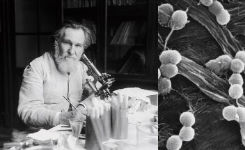
Once upon a time, more than a century ago, Elie Metchnikoff hypothesized that health could be improved, and senility delayed by modulating the intestinal microbes thanks to bacteria present in yogurt. This zoologist and microbiologist was thus one of the first scientists to take an interest in gut microbiota and what we now call probiotics, the consumption of which he claimed helped to fight against aging.
This is the story of “the man who wanted to extend lifespan”.
Elie Metchnikoff was born in 1845 in a village in Russia. Forty-three years later, this Doctor of Science became head of the “morphological microbiology” unit at the Pasteur Institute. During this period, he demonstrated the elimination of foreign particles by devouring cells that he called “phagocytes”, which he understood were essential for protection against infections. This research earned him the title of Director of Scientific Research at the Pasteur Institute and the Nobel Prize in 1908 for his work on immunity.
Elie Metchnikoff
At the end of his career, as his vigor began to decline, Elie Metchnikoff became interested in the mechanisms responsible for senility and the means to slow them down. Because of his background, his attention was drawn to the inhabitants of Eastern Europe, particularly the Balkan states and Russia, which have an unusually high number of centenarians. Elie hypothesized that Bulgarian peasants owed their remarkable longevity to their high consumption of fermented dairy products.
To confirm his theory, the scientist immersed himself in the study of the structure and intestinal contents of many animal species and humans, bringing to light a multitude of putrefactive microbes, which can produce poisons. He identified bacteria such as Bacillus putrificus, sporogenes or welchii, capable of producing toxins such as paracresol and indol, which accelerate aging. In connection with his work on phagocytes, he then thought that the degenerations linked to old age were caused by phagocytes transformed into destroyers of healthy tissues due to intestinal bacterial toxins.
He then came up with the idea that the ingestion of Lactobacillus from fermentation reduces the toxicity of the endogenous microflora, exerting in return a beneficial influence on health.
By supplementing his diet and that of his animals with probiotics, Elie was able to directly observe a reduction in the level of toxins in the urine.
Elie thus affirmed that it is possible to “modify the flora of the organism and to replace harmful microbes by useful microbes”, reducing the deleterious effect of toxic compounds coming from putrefactive bacteria, which delays in fine the appearance of senility. Far from necessarily having a harmful effect on humans, bacteria can, on the contrary, contribute to their well-being. This was a novel idea!
Note also that this new way of eating allowed him to better face the trials and tribulations of life; as a scientist and philosopher, he shared his optimistic vision of human nature through various writings and recommendations.
These constitute the foundations of research on the beneficial effects of lactic ferments and on the importance of microbial diversity for health.
News and articles
Legionella pneumophila: achieving homogeneity with a bacterium prone to aggregation
In this second episode dedicated to fastidious bacteria, let’s take a closer look at Legionella pneumophila. Its cultivation requires a specific medium, notably enriched with L-cysteine and iron. With this species, medium composition, incubation time, and the timing of readout directly influence bacterial recovery.
Characterization of PDRN in cosmetic active ingredients
PDRN is attracting growing interest in dermatology, aesthetic medicine, and the development of cosmetic active ingredients. Long associated with preparations derived from salmonids, PDRN is now also being investigated from plant and algal sources. This diversification of raw materials and production processes calls for characterization tailored to each preparation, in order to compare ingredients using documented scientific criteria and support their development.
Borrelia : quantitative precision at the heart of inoculum preparation
First episode dedicated to fastidious bacteria: Borrelia, the spirochetes responsible for borreliosis, or Lyme disease, for which accurate enumeration directly determines the quality of the inoculum.
At Smaltis, we work in particular with Borrelia afzelii, Borrelia burgdorferisensu stricto, and Borrelia garinii, three major species of the Borrelia burgdorferi sensu lato complex involved in borreliosis, or Lyme disease.
Cutibacterium acnes: when the strain matters as much as the species
À la surface de notre peau et au cœur des follicules pilo-sébacés vit une bactérie bien connue : Cutibacterium acnes. Particulièrement abondante dans les zones riches en sébum, cette bactérie à Gram positif et anaérobie aérotolérante est fréquemment associée à l’acné.
Pourtant, sa présence n’est pas en elle-même le signe d’un déséquilibre. C. acnes fait partie du microbiote cutané normal et se retrouve aussi bien sur une peau saine que sur une peau à tendance acnéique. Certaines études ont même montré que son abondance globale pouvait être relativement comparable dans ces deux situations.
Le rôle de C. acnes ne peut donc pas être compris en recherchant uniquement sa présence ou en mesurant sa quantité. Il dépend également de la composition de sa population, des propriétés des souches qui la constituent et de leurs interactions avec leur environnement.
Resistance of Pseudomonas aeruginosa to odilorhabdins: MexXY(OprM) at the heart of the bacterial response
Why can an antibiotic active against several Gram-negative bacteria lose much of its efficacy against Pseudomonas aeruginosa?
A study published in 2026 in Microbiology Spectrum, to which Smaltis contributed, provides new insights into this question. It shows that the MexXY(OprM) efflux pump plays a major role in the resistance of P. aeruginosa to odilorhabdins, a new class of antibiotics targeting the bacterial ribosome.
Beyond this finding, the study illustrates an essential reality in the development of new antimicrobials: knowing a compound’s target is not enough. It is also necessary to understand how the bacterium detects it, adapts to it, and organises its defence
Choosing the Right Strain to Build a Relevant Microbiological Model
In microbiology, a strain is never just another component of a protocol. It carries a genome, a history and an origin that determine what an experiment can truly reveal. Two strains belonging to the same species can therefore generate different results, all technically valid, yet not necessarily answering the same scientific question.
This is why, at Smaltis, strain selection is an integral part of experimental design. Before searching a collection or looking for a specific isolate, we first clarify the objective of the project: is the aim to standardize a method, understand a mechanism, evaluate an antimicrobial compound, reproduce a resistance phenotype, or represent a clinical situation? The answer then determines the most appropriate model: a reference strain, a human, veterinary or environmental isolate, a strain panel, an available mutant, or a custom-built strain.
Once upon a time, there was a scent so familiar that it was given its own name: petrichor.
It is the unmistakable fragrance that rises from the ground after the first drops of a summer rain fall onto dry soil. A comforting, almost universal scent that evokes woodland walks, gardens after a thunderstorm, or cherished childhood memories. For centuries, people simply believed it was the smell of wet earth. The truth, however, proved far more fascinating.
Management of Microbiological Contamination: Identifying, Understanding and Preventing Recurrence
Microbiological contamination is not limited to a non-compliant result. In R&D development, quality control, an industrial process or biological production, it immediately raises concrete questions: where does the contaminant come from, is it isolated or recurrent, what is its impact, and how can its reappearance be prevented?
The response is not simply to identify the bacterium and then restart the process. To achieve lasting control of bacterial contamination, the investigation must be able to connect laboratory observations with the real operational context: samples, flows, raw materials, equipment, cleaning, disinfection and field practices.
At Smaltis, we approach these situations as a structured microbiological investigation: understanding the problem, isolating the contaminants, identifying and comparing the isolates, preserving useful material, and then testing appropriate prevention solutions.
Skin Microbiome: Cultivating Rigor to Objectify Innovation
The skin microbiome is not mere scenery. It is a functional component of the skin, involved in protection against pathogens, immune dialogue, and the modulation of inflammation. It is a dynamic ecosystem shaped by subtle interactions between bacteria, yeasts, the host, and the environment.
Our approach is grounded in a simple conviction: understanding a microbiome is not merely about identifying it. It is about knowing how to culture it, interrogate it, and generate scientifically defensible data.
This is precisely how we approach the skin microbiome: as a complex ecosystem whose actors, dynamics, and mechanisms must be mastered before attempting to modulate its balance.
Once upon a time, in the hospitals of the twenty-first century, there was an infection that even antibiotics could no longer silence. An opportunistic infection caused by a bacterium called Clostridioides difficile, it often appeared in patients who were already vulnerable… and, above all, already heavily treated. Let us look back at the history of this infection, which gave rise to new therapeutic approaches.

 All articles