From natural odilorhabdins to NOSO-502
Odilorhabdins, or ODLs, are cationic antibiotic peptides initially discovered in Xenorhabdus nematophila. This bacterium lives in symbiosis with the entomopathogenic nematode Steinernema carpocapsae, which carries it into the insects it infects.
Once released inside the insect, X. nematophila contributes to host death and protects this nutrient-rich environment from competing microorganisms. To do so, it produces numerous antimicrobial metabolites. Exploring this remarkable chemical diversity led to the isolation of the first natural odilorhabdins, including NOSO-95A, NOSO-95B and NOSO-95C.
Studies on NOSO-95C showed that odilorhabdins bind to the 30S ribosomal subunit, close to the decoding centre. In doing so, they disrupt mRNA reading and reduce the fidelity of protein synthesis. Their synthesis and subsequent optimisation through medicinal chemistry led to the development of NOSO-502, a compound displaying strong activity against various multidrug-resistant Enterobacterales.
One challenge remained, however: NOSO-502 showed very limited activity against P. aeruginosa. Its mechanism of action provided an initial clue as to why, since ribosomal stress can trigger the expression of the mexXY (oprM) efflux system in this bacterium.
When ribosomal stress triggers MexXY(OprM) expression
MexXY(OprM) is not merely an efflux pump produced at a constant level. Expression of the mexXY operon can increase when ribosomal function is disrupted.
This phenomenon had already been observed with several classes of antibiotics targeting protein synthesis, including aminoglycosides, tetracyclines, macrolides and chloramphenicol. Despite having different chemical structures and binding sites, all of these compounds can increase mexXY expression when they interfere with ribosomal function.
Other signals can also activate this system. Studies focusing on the ParRS regulatory system have shown that the same adaptive response can combine increased mexXY expression, activation of the arnBCADTEF-ugd operon and decreased oprD expression.
Colistin illustrates this complexity. It does not target the ribosome and is not considered an efficient substrate of MexXY(OprM). Nevertheless, through ParRS, it can activate an adaptive response in which MexXY contributes.
The study of odilorhabdins therefore follows on from mechanisms previously described. However, it goes a step further by distinguishing two separate properties: a molecule’s ability to be exported by MexXY(OprM) and its ability to stimulate expression of the genes encoding this pump.
NOSO-502: a compound strongly counteracted by MexXY(OprM)
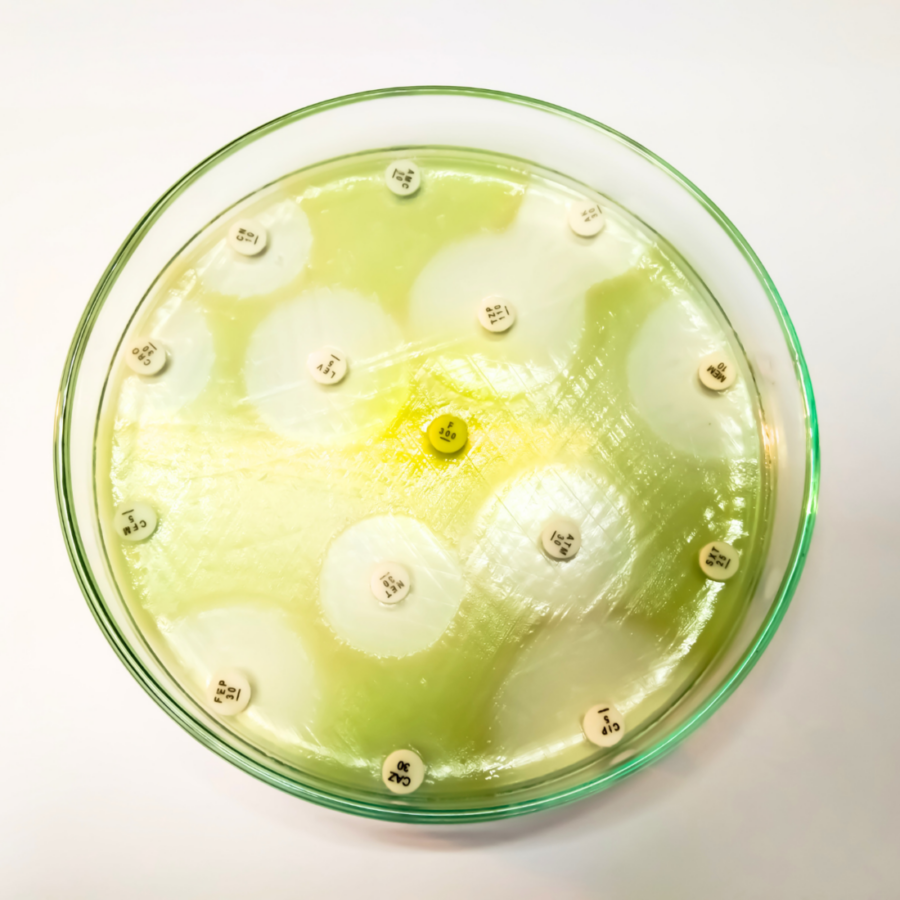
The authors first evaluated the activity of NOSO-502 and NOSO-95C against fifteen P. aeruginosa strains. This panel included reference strains and clinical isolates with different antibiotic resistance profiles.
All tested strains showed low susceptibility to NOSO-502. To identify the mechanism responsible, the researchers then used the PAO1 reference strain together with several derivative strains carrying alterations in different efflux systems.
The result was particularly striking: in PAO1, the minimum inhibitory concentration of NOSO-502 was greater than or equal to 512 µg/mL. When the mexXY or oprM genes were inactivated, this value fell to 2 µg/mL, representing a decrease of more than 256-fold.
MexXY(OprM) therefore represents the main efflux system responsible for the intrinsic resistance of PAO1 to NOSO-502.
But the compound is not simply exported. Under the experimental conditions investigated, exposure to NOSO-502 also caused an approximately 170-fold increase in the amount of mexY transcript. This transcriptional response was accompanied by a functional increase in efflux activity.
NOSO-502 is therefore both a substrate of MexXY(OprM) and a strong inducer of the system contributing to its elimination. In other words, the presence of the antibiotic stimulates one of the main bacterial defence mechanisms capable of reducing its own activity.
NOSO-95C reveals an essential distinction
NOSO-95C is also recognised and exported by MexXY(OprM). Yet it retains measurable antibacterial activity against PAO1 and induces mexXY expression to a much lower extent under the tested conditions.
This comparison highlights an important distinction in the development of new antibiotics:
- a compound can be transported by an efflux pump
- it can also stimulate the expression of the genes encoding that pump
- these two properties can both influence antibacterial activity, but they are not equivalent.
This difference helps explain why two chemically related odilorhabdins can display very different levels of activity against the same bacterium.
Structure–activity relationship analyses notably identified two key regions: the amino acid located at position 7 and the C-terminal region of the molecule. Modifying these regions influences both the recognition of odilorhabdins by MexXY(OprM) and their ability to induce mexXY expression.
Designing an antibiotic also means anticipating the bacterial response
These results provide directly applicable insights for medicinal chemistry. Optimising an antibiotic should not only aim to strengthen its interaction with its target or improve its penetration into the bacterium. It should also seek to reduce its recognition by efflux pumps, its ability to stimulate their production, and the other adaptive responses triggered by exposure to the compound.
In the case of odilorhabdins, certain structural modifications could therefore help preserve ribosomal activity while reducing the induction of MexXY(OprM).
This approach requires microbiological models that go beyond simply measuring antibacterial activity. Determining an MIC shows whether a compound inhibits bacterial growth. The use of mutant strains and genetically characterised models then makes it possible to understand why it works — or why it fails.
Smaltis’ long-standing expertise in MexXY(OprM)
Smaltis’ contribution to this publication builds on long-standing scientific expertise.
Cédric Muller’s doctoral research focused on the characterisation of P. aeruginosa mutants overproducing MexXY(OprM). His work notably contributed to the description of the ParRS regulatory system and its links with mexXY, arnBCADTEF-ugd and oprD. Sophie Guénard, meanwhile, studied the functioning and dysregulation of efflux systems in clinical strains of P. aeruginosa. Both are co-authors of this new publication.
This continuity between academic and applied research now supports the expertise provided by the Smaltis scientific team.

 All articles