Antimicrobial activity testing: measuring, understanding, and anticipating resistance
Published on 25/11/25 in the following categories Antimicrobials
Every day, antimicrobials face their natural adversaries: bacteria.
But in this silent war, nothing remains static — bacteria learn, adapt, defend themselves… and develop increasingly sophisticated resistance mechanisms.
Smaltis is a microbiology CRO specialized in the study of antimicrobial resistance and the preclinical development of antimicrobials.
We support the developers of new antibiotics, peptides, biocides, and other anti-infective agents with a comprehensive panel of in vitro assays designed to meet the most demanding R&D challenges.
Measuring antimicrobial efficacy: MIC, MBC and Time-Kill Curves
Before exploring resistance mechanisms, it is essential to accurately quantify the activity of an antimicrobial compound. Two key values must be determined:
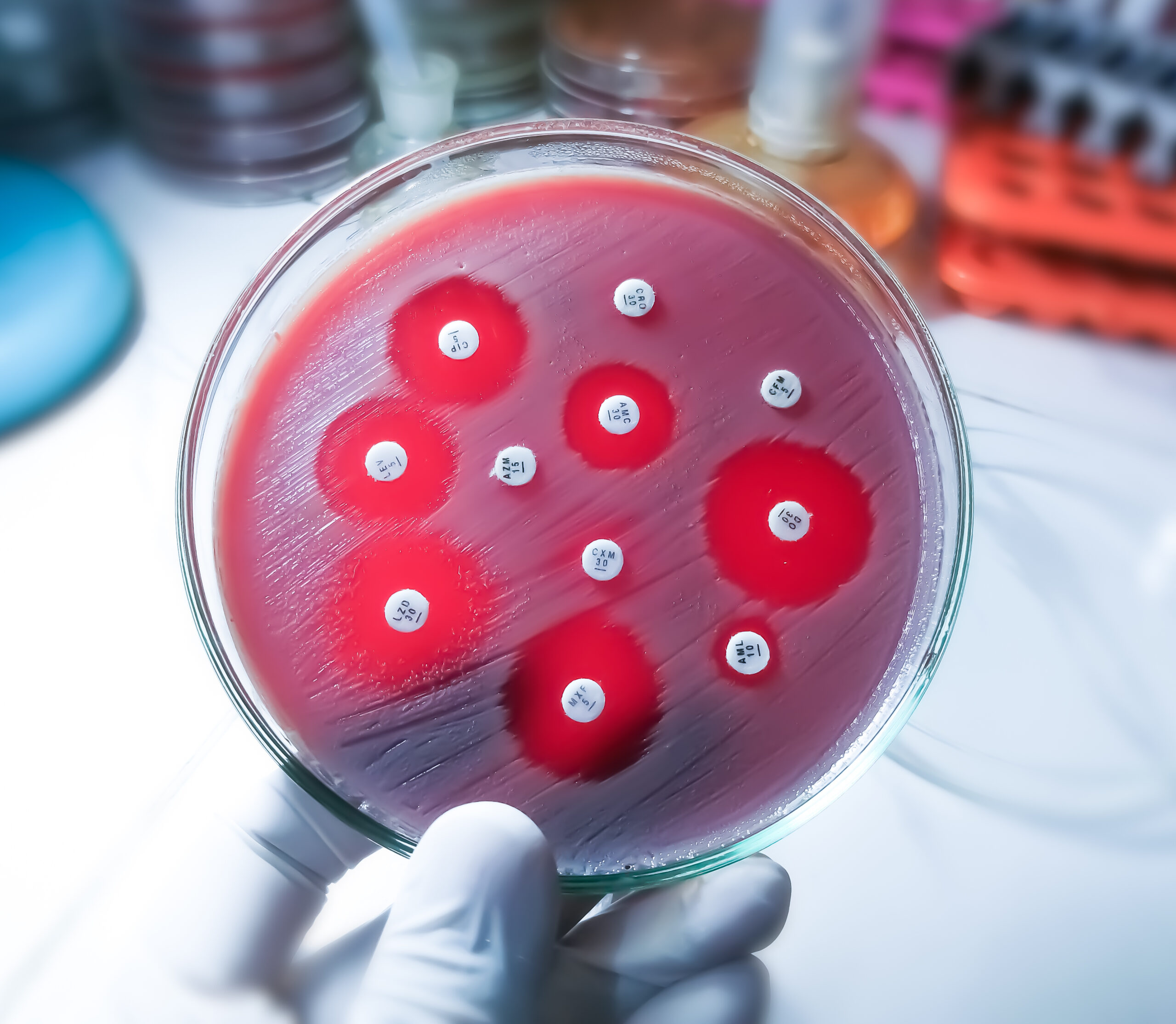
The MIC (Minimum Inhibitory Concentration) represents the lowest concentration of an antimicrobial that prevents bacterial growth.
The MBC (Minimum Bactericidal Concentration) reflects the concentration required to eradicate the bacterial population rather than merely inhibit its growth.
At Smaltis, these assays are performed in compliance with EUCAST or CLSI guidelines to generate robust, internationally comparable data.
MIC/MBC values are far more than catalog figures — they form essential anchors for PK/PD approaches, linking:
• in vivo exposure (Cmax, AUC, time above threshold)
• with in vitro activity, to guide dose selection, dosing regimens, and the design of (pre)clinical studies.
To go beyond this “static” view, we perform Time-Kill Curves, which track bacterial population dynamics over time in the presence of the compound, alone or in combination.
They allow researchers to:
• assess the speed and extent of bactericidal action,
• visualize potential regrowth or tolerance phenomena,
• and compare killing profiles across candidates.
In practice, the combination of these assays provides a complete, static-and-dynamic picture of your antimicrobial candidate’s efficacy in vitro.
Exploring synergies: FIC Index
Infections are rarely controlled by a single treatment, and optimizing therapeutic combinations has become a major challenge in anti-infective development.
The FIC (Fractional Inhibitory Concentration) Index assesses interactions between two antimicrobials — synergy, additivity, indifference, or antagonism.
Complementing efficacy data, the FIC Index provides a specific read-out of compound interactions, essential for optimizing antibiotic combinations or antibiotic-adjuvant strategies and limiting the emergence of resistance.
Anticipating resistance: Serial Passage & Spontaneous Mutants
A highly active candidate in vitro today may lose its effectiveness tomorrow if resistance emerges rapidly within target bacterial populations.
To address this evolutionary dimension early in preclinical development, we conduct two key analyses:
Serial Passage
Through successive passages of a strain under increasing or constant antimicrobial pressure, we simulate prolonged exposure to your compound.
Objective: detect and quantify acquired resistance, through MIC shifts or phenotypic changes.
Selection of Spontaneous Mutants
We evaluate the natural frequency of resistant mutant emergence within a bacterial population exposed to your compound.
These tests make it possible to:
• estimate the evolutionary risk associated with a candidate,
• compare multiple molecules,
• and guide combination or optimization strategies to limit resistance selection.
Deciphering resistance mechanisms
Observing a resistance profile is not enough — understanding its origin is crucial for informed decision-making.
We combine microbiology and molecular biology to characterize underlying mechanisms:
• analysis of known or newly identified resistance genes,
• study of chromosomal mutations and plasmid transfers,
• phenotypic assessment of mechanisms such as efflux pumps, membrane permeability alterations, or enzyme overproduction.
We also work with genetically defined bacterial backgrounds carrying specific resistance profiles, enabling us to:
• isolate the impact of a given mechanism,
• understand how it influences compound activity,
• and rationally guide development decisions.
Ultimately, this approach provides a fine-grained understanding of resistance mechanisms to support your strategic choices — from target indications to combination design, dose selection, or patient stratification.
Custom microbial models and study designs for your mechanism of action
Beyond standard testing, many antimicrobial projects require demonstrating or refining a candidate’s mechanism of action — on membranes, metabolism, essential biosynthetic pathways, cell surface interactions, biofilm formation, and more.
At Smaltis, we design tailor-made experimental roadmaps that include:
• critical review of existing data and literature,
• definition of realistic mechanistic hypotheses,
• selection and prioritization of the most informative assays,
• integrated into a structured plan with milestones and Go/No-Go decisions.
Our teams then handle the execution of in vitro assays, method optimization and validation, and data interpretation — to demonstrate, identify, or characterize your candidate’s mechanism of action.
The goal: to link robust phenotypic observations to a clear mechanistic narrative, directly exploitable for your development strategy, regulatory submissions, and scientific communication.
Let’s discuss your antimicrobial projects!
News and articles
Borrelia : quantitative precision at the heart of inoculum preparation
First episode dedicated to fastidious bacteria: Borrelia, the spirochetes responsible for borreliosis, or Lyme disease, for which accurate enumeration directly determines the quality of the inoculum.
At Smaltis, we work in particular with Borrelia afzelii, Borrelia burgdorferisensu stricto, and Borrelia garinii, three major species of the Borrelia burgdorferi sensu lato complex involved in borreliosis, or Lyme disease.
Cutibacterium acnes: when the strain matters as much as the species
À la surface de notre peau et au cœur des follicules pilo-sébacés vit une bactérie bien connue : Cutibacterium acnes. Particulièrement abondante dans les zones riches en sébum, cette bactérie à Gram positif et anaérobie aérotolérante est fréquemment associée à l’acné.
Pourtant, sa présence n’est pas en elle-même le signe d’un déséquilibre. C. acnes fait partie du microbiote cutané normal et se retrouve aussi bien sur une peau saine que sur une peau à tendance acnéique. Certaines études ont même montré que son abondance globale pouvait être relativement comparable dans ces deux situations.
Le rôle de C. acnes ne peut donc pas être compris en recherchant uniquement sa présence ou en mesurant sa quantité. Il dépend également de la composition de sa population, des propriétés des souches qui la constituent et de leurs interactions avec leur environnement.
Resistance of Pseudomonas aeruginosa to odilorhabdins: MexXY(OprM) at the heart of the bacterial response
Why can an antibiotic active against several Gram-negative bacteria lose much of its efficacy against Pseudomonas aeruginosa?
A study published in 2026 in Microbiology Spectrum, to which Smaltis contributed, provides new insights into this question. It shows that the MexXY(OprM) efflux pump plays a major role in the resistance of P. aeruginosa to odilorhabdins, a new class of antibiotics targeting the bacterial ribosome.
Beyond this finding, the study illustrates an essential reality in the development of new antimicrobials: knowing a compound’s target is not enough. It is also necessary to understand how the bacterium detects it, adapts to it, and organises its defence
Choosing the Right Strain to Build a Relevant Microbiological Model
In microbiology, a strain is never just another component of a protocol. It carries a genome, a history and an origin that determine what an experiment can truly reveal. Two strains belonging to the same species can therefore generate different results, all technically valid, yet not necessarily answering the same scientific question.
This is why, at Smaltis, strain selection is an integral part of experimental design. Before searching a collection or looking for a specific isolate, we first clarify the objective of the project: is the aim to standardize a method, understand a mechanism, evaluate an antimicrobial compound, reproduce a resistance phenotype, or represent a clinical situation? The answer then determines the most appropriate model: a reference strain, a human, veterinary or environmental isolate, a strain panel, an available mutant, or a custom-built strain.
Once upon a time, there was a scent so familiar that it was given its own name: petrichor.
It is the unmistakable fragrance that rises from the ground after the first drops of a summer rain fall onto dry soil. A comforting, almost universal scent that evokes woodland walks, gardens after a thunderstorm, or cherished childhood memories. For centuries, people simply believed it was the smell of wet earth. The truth, however, proved far more fascinating.
Management of Microbiological Contamination: Identifying, Understanding and Preventing Recurrence
Microbiological contamination is not limited to a non-compliant result. In R&D development, quality control, an industrial process or biological production, it immediately raises concrete questions: where does the contaminant come from, is it isolated or recurrent, what is its impact, and how can its reappearance be prevented?
The response is not simply to identify the bacterium and then restart the process. To achieve lasting control of bacterial contamination, the investigation must be able to connect laboratory observations with the real operational context: samples, flows, raw materials, equipment, cleaning, disinfection and field practices.
At Smaltis, we approach these situations as a structured microbiological investigation: understanding the problem, isolating the contaminants, identifying and comparing the isolates, preserving useful material, and then testing appropriate prevention solutions.
Skin Microbiome: Cultivating Rigor to Objectify Innovation
The skin microbiome is not mere scenery. It is a functional component of the skin, involved in protection against pathogens, immune dialogue, and the modulation of inflammation. It is a dynamic ecosystem shaped by subtle interactions between bacteria, yeasts, the host, and the environment.
Our approach is grounded in a simple conviction: understanding a microbiome is not merely about identifying it. It is about knowing how to culture it, interrogate it, and generate scientifically defensible data.
This is precisely how we approach the skin microbiome: as a complex ecosystem whose actors, dynamics, and mechanisms must be mastered before attempting to modulate its balance.
Once upon a time, in the hospitals of the twenty-first century, there was an infection that even antibiotics could no longer silence. An opportunistic infection caused by a bacterium called Clostridioides difficile, it often appeared in patients who were already vulnerable… and, above all, already heavily treated. Let us look back at the history of this infection, which gave rise to new therapeutic approaches.
Probiotic Characterization: Demonstrating Safety and Substantiating Activity
Probiotics are often presented as a simple category. In reality, their characterization has become a demanding scientific and regulatory exercise. It is no longer enough to identify a species or to invoke a favorable history of use: the demonstration must now be conducted at the strain level, in a way that is consistent with the intended use, the target population, and the applicable regulatory framework. In the main reference frameworks, a microorganism can be qualified as a probiotic in the strict sense only if it is sufficiently characterized, safe for its intended use, alive at a relevant dose until the end of the product’s shelf life, and associated with a documented health benefit. [1,5,7,8]
The key question therefore becomes: what can we robustly demonstrate about its identity, safety, and functional activity? This is particularly true for new or poorly documented strains, for which taxonomy alone is not sufficient. The EFSA, GRAS, and Canadian frameworks converge on one central point: useful characterization is strain-level characterization interpreted in light of the final use. [1-6]
Designing Bacterial Mutants: From Gene Editing to Robust Strain Engineering
The construction of bacterial mutants is a cornerstone of microbiology. Historically used to decipher gene function, it now plays an equally strategic role in bioproduction, biotechnology, and the development of therapeutic bacteria, where the engineered strain itself may ultimately become the final product.
This shift has profoundly changed how mutagenesis projects are approached. Today, the objective is no longer simply to modify a gene, but to design a strain aligned with its final application, operational constraints, and regulatory expectations.

 All articles