
All articles

The man who wanted to extend lifespan

Published on 18/12/23 in the following categories Microbiota

Once upon a time, more than a century ago, Elie Metchnikoff hypothesized that health could be improved, and senility delayed by modulating the intestinal microbes thanks to bacteria present in yogurt. This zoologist and microbiologist was thus one of the first scientists to take an interest in gut microbiota and what we now call probiotics, the consumption of which he claimed helped to fight against aging.

This is the story of “the man who wanted to extend lifespan”.

Elie Metchnikoff was born in 1845 in a village in Russia. Forty-three years later, this Doctor of Science became head of the “morphological microbiology” unit at the Pasteur Institute. During this period, he demonstrated the elimination of foreign particles by devouring cells that he called “phagocytes”, which he understood were essential for protection against infections. This research earned him the title of Director of Scientific Research at the Pasteur Institute and the Nobel Prize in 1908 for his work on immunity.
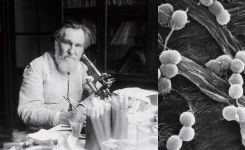
Elie Metchnikoff

Elie Metchnikoff

At the end of his career, as his vigor began to decline, Elie Metchnikoff became interested in the mechanisms responsible for senility and the means to slow them down. Because of his background, his attention was drawn to the inhabitants of Eastern Europe, particularly the Balkan states and Russia, which have an unusually high number of centenarians. Elie hypothesized that Bulgarian peasants owed their remarkable longevity to their high consumption of fermented dairy products.

To confirm his theory, the scientist immersed himself in the study of the structure and intestinal contents of many animal species and humans, bringing to light a multitude of putrefactive microbes, which can produce poisons. He identified bacteria such as Bacillus putrificus, sporogenes or welchii, capable of producing toxins such as paracresol and indol, which accelerate aging. In connection with his work on phagocytes, he then thought that the degenerations linked to old age were caused by phagocytes transformed into destroyers of healthy tissues due to intestinal bacterial toxins.

He then came up with the idea that the ingestion of Lactobacillus from fermentation reduces the toxicity of the endogenous microflora, exerting in return a beneficial influence on health.
By supplementing his diet and that of his animals with probiotics, Elie was able to directly observe a reduction in the level of toxins in the urine.
Elie thus affirmed that it is possible to “modify the flora of the organism and to replace harmful microbes by useful microbes”, reducing the deleterious effect of toxic compounds coming from putrefactive bacteria, which delays in fine the appearance of senility. Far from necessarily having a harmful effect on humans, bacteria can, on the contrary, contribute to their well-being. This was a novel idea!

Note also that this new way of eating allowed him to better face the trials and tribulations of life; as a scientist and philosopher, he shared his optimistic vision of human nature through various writings and recommendations.

These constitute the foundations of research on the beneficial effects of lactic ferments and on the importance of microbial diversity for health.

News and articles

Management of Microbiological Contamination: Identifying, Understanding and Preventing Recurrence

Microbiological contamination is not limited to a non-compliant result. In R&D development, quality control, an industrial process or biological production, it immediately raises concrete questions: where does the contaminant come from, is it isolated or recurrent, what is its impact, and how can its reappearance be prevented?

The response is not simply to identify the bacterium and then restart the process. To achieve lasting control of bacterial contamination, the investigation must be able to connect laboratory observations with the real operational context: samples, flows, raw materials, equipment, cleaning, disinfection and field practices.

At Smaltis, we approach these situations as a structured microbiological investigation: understanding the problem, isolating the contaminants, identifying and comparing the isolates, preserving useful material, and then testing appropriate prevention solutions.

READ THE POST

Skin Microbiome: Cultivating Rigor to Objectify Innovation

The skin microbiome is not mere scenery. It is a functional component of the skin, involved in protection against pathogens, immune dialogue, and the modulation of inflammation. It is a dynamic ecosystem shaped by subtle interactions between bacteria, yeasts, the host, and the environment.

Our approach is grounded in a simple conviction: understanding a microbiome is not merely about identifying it. It is about knowing how to culture it, interrogate it, and generate scientifically defensible data.

This is precisely how we approach the skin microbiome: as a complex ecosystem whose actors, dynamics, and mechanisms must be mastered before attempting to modulate its balance.

READ THE POST

The Story of a Microbiota That Became a Medicine

Once upon a time, in the hospitals of the twenty-first century, there was an infection that even antibiotics could no longer silence. An opportunistic infection caused by a bacterium called Clostridioides difficile, it often appeared in patients who were already vulnerable… and, above all, already heavily treated. Let us look back at the history of this infection, which gave rise to new therapeutic approaches.

READ THE POST

Probiotic Characterization: Demonstrating Safety and Substantiating Activity

Probiotics are often presented as a simple category. In reality, their characterization has become a demanding scientific and regulatory exercise. It is no longer enough to identify a species or to invoke a favorable history of use: the demonstration must now be conducted at the strain level, in a way that is consistent with the intended use, the target population, and the applicable regulatory framework. In the main reference frameworks, a microorganism can be qualified as a probiotic in the strict sense only if it is sufficiently characterized, safe for its intended use, alive at a relevant dose until the end of the product’s shelf life, and associated with a documented health benefit. [1,5,7,8]

The key question therefore becomes: what can we robustly demonstrate about its identity, safety, and functional activity? This is particularly true for new or poorly documented strains, for which taxonomy alone is not sufficient. The EFSA, GRAS, and Canadian frameworks converge on one central point: useful characterization is strain-level characterization interpreted in light of the final use. [1-6]

READ THE POST

Designing Bacterial Mutants: From Gene Editing to Robust Strain Engineering

The construction of bacterial mutants is a cornerstone of microbiology. Historically used to decipher gene function, it now plays an equally strategic role in bioproduction, biotechnology, and the development of therapeutic bacteria, where the engineered strain itself may ultimately become the final product.

This shift has profoundly changed how mutagenesis projects are approached. Today, the objective is no longer simply to modify a gene, but to design a strain aligned with its final application, operational constraints, and regulatory expectations.

READ THE POST

Lugdunin: the secret weapon of an indomitable bacterium

Once upon a time, an invisible battle was raging deep inside our noses. A microscopic battlefield, where bacteria fought relentlessly to defend their territory. Picture a small village of indomitable Gauls, surrounded on all sides… but instead of Romans, it’s microbes. And in this surprisingly strategic setting, a most unexpected antibiotic was discovered: lugdunin.

READ THE POST

2026: Taking on New Scientific Challenges Together

As we step into 2026, the entire Smaltis team sends you our warmest wishes. May this new year bring clarity, creativity, meaningful collaborations — and a few scientific breakthroughs that get the attention they deserve.

READ THE POST

Antimicrobial activity testing: measuring, understanding, and anticipating resistance

Every day, antimicrobials face their natural adversaries: bacteria.
But in this silent war, nothing remains static — bacteria learn, adapt, defend themselves… and develop increasingly sophisticated resistance mechanisms.
Smaltis is a microbiology CRO specialized in the study of antimicrobial resistance and the preclinical development of antimicrobials.
We support the developers of new antibiotics, peptides, biocides, and other anti-infective agents with a comprehensive panel of in vitro assays designed to meet the most demanding R&D challenges.

READ THE POST

Meeting the Innovation

Smaltis at the Key Industry Events of Autumn 2025! From medical devices to biotherapies, from fundamental research to industrial production, we meet project leaders to better understand microbiology needs and build new collaborations.

READ THE POST

New Offer Structure: 2 Business Units Supporting Your Projects

At Smaltis, our ambition remains unchanged: bringing microbiological excellence to your innovations.
To better address the diversity of your needs, we have structured our offer around 2 complementary Business Units, true pillars of our scientific and technical commitment.

READ THE POST

Let's study your project!

Are you interested in our services? Ask our experts to study your needs and design a tailor-made collaboration with you.

Book a discovery call